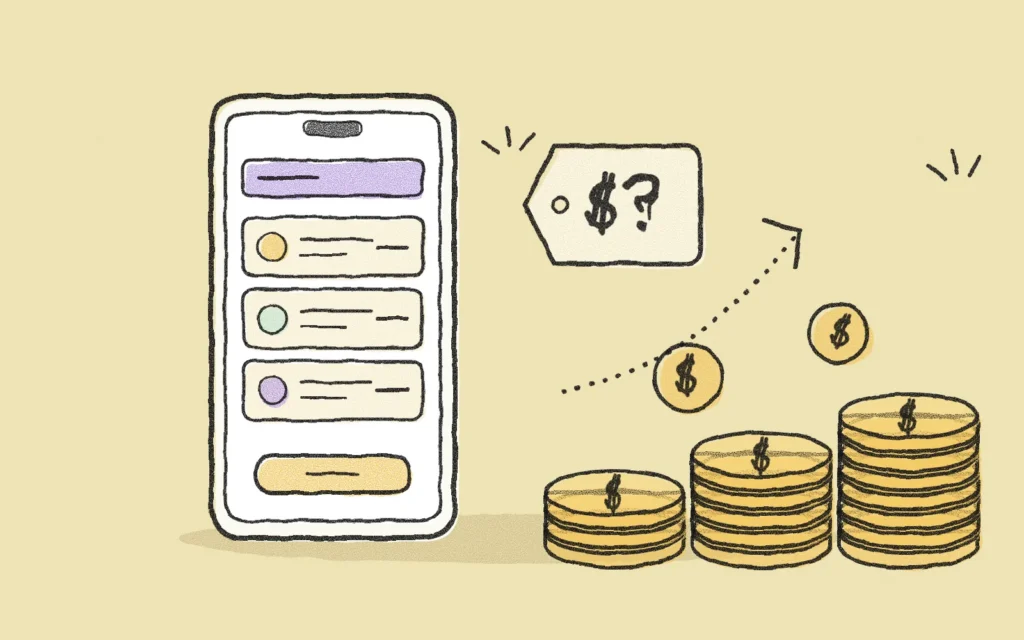
The cost of developing an app depends on five variables: how many features it has, which platforms it targets, which systems it connects to, how much design it needs and what support it requires after launch. That is why two apps that “look the same” can have very different budgets. In this guide we explain how we think about a budget at QKStudio, after almost 20 years of developing apps for companies, government, healthcare and education.
The 5 factors that define the cost of an app
1. Scope: how many screens and features
This is the factor that weighs the most. An app with sign-up, a catalog and a contact form has nothing in common with one that has payments, real-time chat, geolocation and an admin panel. Every feature adds design, development and testing.
The key question is not “what could the app have?” but “what does it need so that someone uses it and comes back?”. That is where the MVP comes in.
2. Platforms: iOS, Android or both
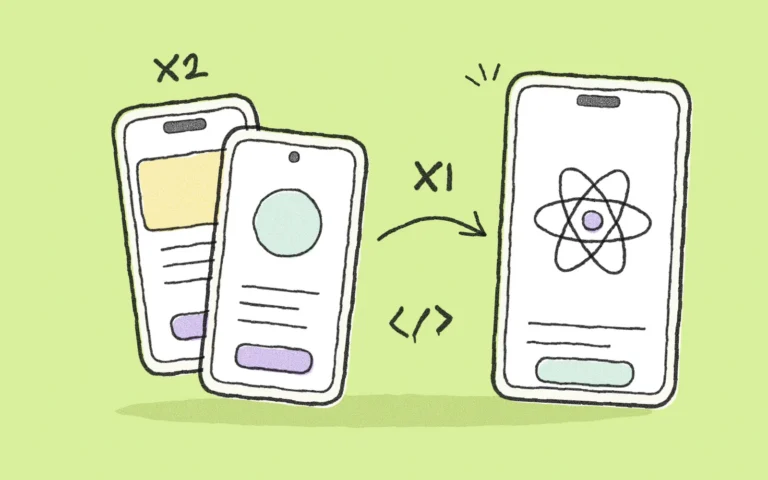
Today almost every project needs to be in both stores. With cross-platform technologies such as React Native you write a single codebase for iOS and Android, which reduces cost and time. Native development (Swift for iOS, Kotlin for Android) is justified when the app makes intensive use of the hardware. We explain it in detail in Native app or React Native: how to choose.
3. Integrations and backend
An app rarely lives alone. It usually connects to a management system, a CRM, a payment gateway, IoT sensors or its own database. Every integration requires analysis, development and testing, and if the existing system has no documented API, the effort grows.
4. UX/UI design
An app can work perfectly from a technical standpoint and still fail because people do not understand how to use it. Investing in user research, prototypes and usability tests costs far less than reprogramming screens after launch. If you want to go deeper, read what UX/UI is and what its process looks like.
5. Support and evolution
The budget does not end the day the app reaches the stores. Apple and Google update their operating systems every year, users ask for improvements and errors need to be monitored. It pays to plan for maintenance from the start.
How a phased budget works
Instead of quoting “the whole app” blindly, we work in phases. That way every investment is made with real information:
- Discovery (1–2 weeks): we define goals, users, MVP features and technology. It has a fixed price and ends with a clear scope.
- UX/UI design (2–4 weeks): flows, a clickable prototype and user testing.
- Development in sprints: deliveries every two weeks that you can try on your own phone.
- Testing and release: on real devices and on the App Store and Google Play.
- Launch and continuous improvement: campaigns, analytics and new features.
A typical project takes between 6 and 16 weeks, depending on scope.
The MVP: the smartest way to start
An MVP (minimum viable product) is the simplest version of your app that solves your users’ main problem. It lets you validate the idea in the market before investing in everything else.
A good MVP:
- Solves one core need very well.
- Can be launched in weeks, not months.
- Measures how people use it from day one.
- Leaves the architecture ready to grow.
Costs many people forget
- Developer accounts: Apple charges an annual membership and Google Play a one-time registration fee.
- Infrastructure: cloud servers, databases and notification services.
- Third-party services: maps, payments, messaging or advanced analytics.
- Launch marketing: an app without downloads produces no results. Campaigns such as Google App Campaigns help you get your first users (more on this in what a Google Partner Premier is).
How do you find out what your app would cost?
The honest answer is: it depends on what you need. What we can do is give you a clear path. In a discovery call we understand your idea, and within a few days we send you a proposal with scope, phases and a budget for each phase.
Have an app idea? Tell us about your project and we will propose a path to your MVP.
Frequently asked questions
Is it cheaper to build a hybrid app?
Generally yes: with React Native most of the code is shared between iOS and Android, which reduces time and cost. The final choice depends on what the app needs to do.
Can I start with a single platform?
Yes, although with cross-platform technologies the cost difference between one and two platforms is usually smaller than people think.
Is the app mine when the project ends?
Yes. We deliver the source code and the documentation.